
When someone texts you “you,” it may seem like the easiest word in English. But a short message can sometimes leave you wondering what the person really means. Did they ask about you? Are they talking about your actions? Or does “you” have a hidden meaning in texting?
The word “you” is common in everyday chats, social media, dating apps, and online communities.
People use it in many ways, and its meaning often depends on the sentence, the situation, and the tone of the conversation.
If you searched for you meaning in text, you are probably trying to understand how this simple word works in modern texting. You may have received a message containing “you” and want to know how to reply.
This guide explains the meaning of “you” in text messages, its common uses, possible tones, and examples from real conversations.
By the end, you will understand how to read this word more clearly and use it naturally in your own chats.
What Does “You Meaning in Text” Mean?
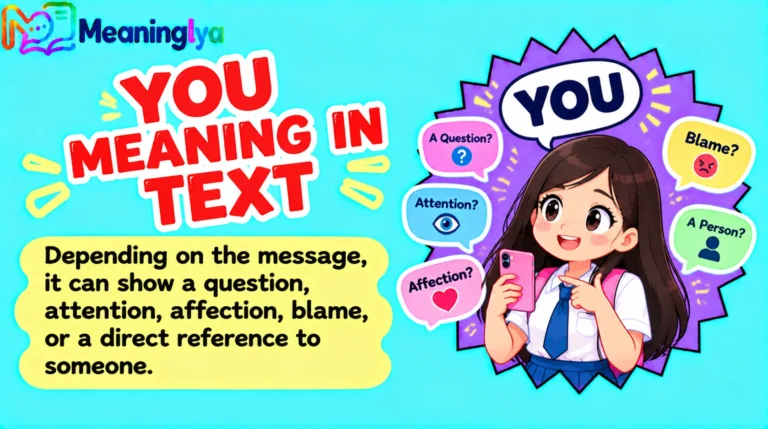
In text messages, “you” means the person being spoken to or addressed. It is a standard English pronoun, not usually slang. Depending on the message, it can show a question, attention, affection, blame, or a direct reference to someone. The meaning comes from the words around it and the conversation’s tone.
Common interpretations include:
- The person being addressed: “You are my friend.”
- A question about someone: “You okay?”
- Emphasis or attention: “You did that?”
- A personal or emotional reference: “Only you understand me.”
The Most Common Meanings of “You”
The word “you” does not have one special meaning in every text conversation. It can serve different purposes depending on how someone writes it. Here are the most common meanings.
1. You as the Person Being Addressed
The basic meaning of “you” is the person receiving the message. It points directly to the reader.
People use it when talking about someone’s actions, feelings, opinions, or plans.
Example:
“You are coming with us tonight?”
Meaning: The sender is asking whether you will join them.
Another example:
“You always make me laugh.”
Meaning: The sender is talking directly to you and saying that you make them laugh often.
This is the most common use of “you” in texting.
2. You in a Question
People often use “you” when asking about another person’s life or plans. The word may appear at the start or end of a short question.
Examples:
- “What are you doing?”
- “You home?”
- “How are you?”
- “You free today?”
These messages are usually casual. They may show interest in your activities or simply keep the conversation going.
For example, if a friend texts “You home?” they probably want to know whether you are at home. If someone you like asks “You free tonight?” they may be checking if you can meet.
The word itself is not romantic. The situation determines whether the question has a deeper meaning.
3. You for Emphasis
Sometimes a sender uses “you” to give extra attention to the person they are talking about. It can make a sentence feel more personal or emotional.
Example:
“You are the one I trust.”
Meaning: The sender is highlighting you as a special or trusted person.
Another example:
“You did this?”
Meaning: The sender is surprised that you did something.
The tone can be positive, playful, or negative. A friendly conversation may make it sound like praise, while an argument may make it sound like blame.
4. You as a Sign of Affection
In some messages, “you” appears in a warm or emotional sentence. It may show that someone values your presence.
Examples:
- “I miss you.”
- “I need you.”
- “You make my day better.”
- “I am happy because of you.”
Here, “you” refers to the person who matters to the sender. It does not automatically mean romance. Friends, family members, and partners can all use it.
To understand the feeling, look at the full sentence and your relationship with the sender.
5. You in a Short or Direct Reply
A person may send only “you?” after you answer a question. This is a very common texting pattern.
Example:
Person A: “I am tired today.”
Person B: “You?”
Person B may be asking, “Are you tired too?” or “How about you?” The exact meaning depends on what was said before.
Another example:
Person A: “I love this song.”
Person B: “You?”
Here, the sender might be asking whether you love the song too, although the wording is incomplete. A short reply like this may sound casual and conversational.
How “You” Is Used in Real Conversations
The word “you” appears in nearly every kind of digital conversation. However, people may use it differently with friends, romantic interests, gaming partners, and coworkers.
Friends & Casual Texting
Friends often use “you” in short questions and relaxed conversations. They may leave out other words because both people understand the context.
Examples:
“You coming?”
Meaning: Are you coming?
“What about you?”
Meaning: The sender wants to know your opinion, activity, or answer.
“You are crazy lol.”
Meaning: The friend is teasing you. It may be playful rather than insulting.
In casual texting, people do not always use complete sentences. A message such as “You okay?” is often a quick way to check on a friend.
The relationship matters. A close friend may use direct language without sounding rude. A stranger using the same words might sound more serious.
Instagram & Snapchat
On Instagram and Snapchat, “you” is often part of quick replies, comments, and direct messages. People may use it when reacting to a story, photo, or video.
Examples:
“You look good!”
Meaning: The sender is complimenting your appearance.
“Is that you?”
Meaning: The sender wants to confirm whether the person in the picture or video is you.
“You need to try this.”
Meaning: The sender is recommending something to you.
A message such as “You?” in response to a story may ask about your opinion or situation. For example, if you post “I am bored,” a friend might reply “You?” meaning, “Are you bored too?”
On social media, the meaning often depends on what was posted before the message.
Dating Apps
On dating apps, people use “you” to ask questions, show interest, or start a personal conversation. It can help move a chat away from simple greetings.
Examples:
“What about you?”
Meaning: The person wants to learn more about your life.
“You seem fun.”
Meaning: The sender thinks you appear interesting or enjoyable to talk to.
“I would rather spend time with you.”
Meaning: The sender is expressing personal interest, which may be romantic depending on the conversation.
However, “you” alone is not a sign of flirting. A person may simply be asking a normal question.
If someone sends only “you?” after you share your plans, they may be asking whether you are available or what you think. Read the full conversation before assuming romantic interest.
Gaming & Online Communities
Gamers and online community members use “you” in direct questions, team communication, and friendly banter.
Examples:
“You joining the next match?”
Meaning: Are you going to play the next match?
“You carried the team.”
Meaning: The sender believes you played a major role in helping the team win.
“You good?”
Meaning: Are you okay, or do you need help?
In gaming, short messages are useful because players may need to communicate quickly. The word “you” helps identify who should act or respond.
Tone can vary. “You are throwing” may be criticism during a match, while “You are cracked” may praise someone’s skill. The surrounding gaming language provides the real meaning.
Work or Professional Chat
In work chats, “you” is used to address coworkers, managers, clients, or other professional contacts. It is a normal pronoun, but the wording should remain clear and polite.
Examples:
“Could you send the report?”
Meaning: The sender is asking you to send the report.
“Are you available for a meeting?”
Meaning: The sender wants to know whether you have time for a meeting.
“Thank you for your help.”
Meaning: The sender is appreciating your assistance.
A single “you?” in a professional conversation may seem unclear or too casual. It is better to use a complete sentence, especially when discussing tasks, deadlines, or important information.
For example, instead of writing “You?” write “Are you available to review this document?”
Is “You” Rude, Flirty, or Offensive?
The word “you” is not rude, flirty, or offensive by itself. It is a normal English pronoun. Its tone depends on the sentence, punctuation, relationship, and situation.
When “You” Feels Positive
“You” can sound positive when it appears in a compliment, thank-you message, or caring question.
Examples:
- “You are so kind.”
- “I appreciate you.”
- “You always help me.”
These messages usually show warmth, respect, or appreciation.
When “You” Feels Flirty
The word may appear in romantic or playful messages, but the complete sentence matters.
Examples:
- “I wish you were here.”
- “You look amazing.”
- “I want to see you again.”
These phrases may suggest attraction, especially when sent by someone who is interested in you.
Still, “you” alone does not prove that someone is flirting. A friendly compliment and a romantic compliment can look similar.
When “You” Feels Rude
A message can sound rude when “you” is used to accuse or blame someone.
Examples:
- “You never listen.”
- “You did this again?”
- “You are the problem.”
These sentences may express frustration. The tone can become stronger during an argument.
Why Context Matters
Text messages do not include voice tone, facial expressions, or body language. Because of this, a short message may be misunderstood.
For example, “You?” could mean:
- “What about you?”
- “Are you the person in the picture?”
- “You did that?”
- “Are you okay?”
The best way to understand it is to consider the previous message and the relationship between the people.
How to Respond When Someone Says “You”
The best reply depends on what the sender means. If the message is unclear, you can ask a simple question instead of guessing.
Casual Replies
Use these when chatting with friends or someone you know well.
- “Me? I’m good.”
- “Yeah, what about you?”
- “I’m here!”
- “What do you mean?”
- “Yep, that’s me.”
Example:
Friend: “You?”
You: “I’m doing good. How about you?”
Funny Replies
A playful reply can work when the conversation is relaxed and both people enjoy jokes.
- “Me, obviously!”
- “Who else?”
- “You found me.”
- “The one and only.”
- “Yes, your favorite person.”
Use humor only when it fits the relationship. A joke may not be suitable if the sender is asking about something serious.
Neutral Replies
Neutral replies are useful when you are unsure about the sender’s intention.
- “Yes?”
- “What do you mean?”
- “Are you asking about me?”
- “Could you explain?”
- “What would you like to know?”
These responses help you understand the message without making assumptions.
Professional Replies
In work conversations, choose a clear and polite response.
- “Yes, how can I help?”
- “Are you asking if I am available?”
- “I am available at 3 PM.”
- “Could you clarify your question?”
- “Yes, I can take care of that.”
For example, if a coworker writes “You?” after discussing a task, you can reply, “Yes, I can handle that. When do you need it?”
Common Misunderstandings About “You”
Because “you” is such a short word, people sometimes assume it has a hidden meaning. Here are some common misunderstandings.
1. Thinking “You” Is Always Flirty
A person may write “you” in a caring or romantic message, but that does not mean the word itself is flirty.
For example, “How are you?” is usually a normal question. “I miss you” may be affectionate, but it can come from a friend or family member too.
The full message matters more than the single word.
2. Assuming “You?” Always Means “What About You?”
This is a common use, but not the only one.
If someone sends “You?” after you say “I am going to the store,” they may ask about your plans or whether you want to go together. If they send “You?” after a photo, they may be asking whether you are in the picture.
Read the previous message to understand the intended meaning.
3. Confusing Directness With Anger
Some people use short messages because they are busy or prefer simple texting. A message like “You free?” is not automatically rude.
However, “You never listen” has a more negative tone because it makes a complaint.
The words around “you” help show whether the sender is being friendly, neutral, or upset.
4. Assuming Capitalization Changes the Meaning
Writing “You,” “you,” or “YOU” can change emphasis, but capitalization does not create a fixed slang definition.
For example:
- “You?” — a short question.
- “YOU did this?” — strong surprise or emphasis.
- “you” — standard lowercase texting.
The context still determines the meaning.
5. Believing “You” Has One Universal Digital Meaning
Texting styles differ between people, age groups, cultures, and platforms. Some people use complete sentences, while others prefer very short messages.
A message that feels normal to one person may seem cold or confusing to another. Do not assume everyone uses “you” in exactly the same way.
Similar Slang Terms You Should Know
The word “you” is not slang, but several texting terms are commonly used in similar situations.
- U — A shortened form of “you,” often used in casual texting.
- UR — An informal abbreviation that can mean “your” or “you’re,” depending on context.
- U2 — A short way to write “you too.”
- HBU — Means “How about you?”
- WBU — Also means “What about you?”
- HBY — A less common abbreviation for “How about you?”
- WYD — Means “What are you doing?”
- WYA — Means “Where you at?” or “Where are you?”
- U OK? — A casual way to ask whether someone is okay.
- You good? — A short question asking if someone is fine or needs help.
These terms can make texting faster, but they are best used when the other person understands informal abbreviations.
When You Should Avoid Using “You”
Although “you” is a normal word, some short messages may not be appropriate in every setting.
Professional Settings
Avoid sending unclear one-word messages when discussing work. A message like “You?” may confuse a manager or client.
Instead, write a complete question:
“Are you available for a quick call?”
Clear language helps prevent misunderstandings.
Cross-Cultural Chats
People from different language backgrounds may understand direct wording differently. A short message such as “You?” might seem confusing or abrupt.
When speaking with someone from another culture, use simple and complete sentences. This makes your meaning easier to understand.
Sensitive Situations
If someone is upset, worried, or discussing a serious issue, avoid playful or unclear replies.
For example, if a friend says, “I am having a hard day,” replying only “You?” may not show enough care.
A better response is:
“I’m sorry you’re having a hard day. Do you want to talk about it?”
In sensitive conversations, kindness and clarity matter more than texting speed.
FAQs
1. What does “you” mean in text messages?
“You” refers to the person being addressed. It is a standard English pronoun used in questions, statements, compliments, and everyday conversations.
2. Is “you” a slang word?
No. “You” is a standard English pronoun. However, shortened forms such as “u” are common in informal texting.
3. What does “you?” mean in a text?
“You?” can mean “What about you?” or ask for clarification about the person being discussed. The exact meaning depends on the previous message.
4. Does “you” mean someone is flirting?
Not by itself. “You” may appear in flirty messages, but it is also used in friendly, family, and professional conversations.
5. What is the difference between “you” and “u”?
“You” is the standard spelling. “U” is an informal texting abbreviation. Both generally refer to the person being addressed.
6. How do I reply when someone texts “you?”
You can reply with “What about me?” or “I’m good, how about you?” If the meaning is unclear, ask, “What do you mean?”
7. Is “you” rude in texting?
No. The word is not rude on its own. A message may sound rude when the surrounding words express blame, anger, or disrespect.
CONCLUSION
The meaning of “you” in text is simple: it refers to the person being addressed. However, its tone and purpose can change depending on the sentence and conversation.
It may be used to ask a question, show attention, express affection, or speak directly to someone. In casual chats, short forms like “you?” are common. In professional or sensitive conversations, complete sentences are often better.
The key is to read the full message instead of judging one word. When you understand the context, you can reply with confidence and avoid unnecessary confusion.
Remember: “You” is a normal English word, not a secret slang code. Use it naturally, pay attention to the conversation, and choose your reply based on what the sender is really asking.

Graham Prescott is a language enthusiast who enjoys exploring English words, meanings, and modern expressions. He writes clear, easy-to-understand content to help readers improve their vocabulary and everyday English.