
When someone texts you “wb,” you might wonder what they mean. Is it a quick greeting, a question, or something else? Short texting words can be confusing, especially when people use them on different apps.
The meaning of “wb meaning in text” is simple in many conversations, but the exact meaning can depend on the situation.
You may see it in a message from a friend, a gaming group, or someone you are getting to know online.
People search for this term because they want to understand a short message without asking the sender and feeling confused.
Knowing these small texting shortcuts can make online conversations easier and more natural.
In this guide, you will learn what WB means in text messages, its common meanings, how people use it on social media, and how to respond.
We will also cover its tone, possible misunderstandings, and situations where another word may be better.
What Does “WB Meaning in Text” Mean?
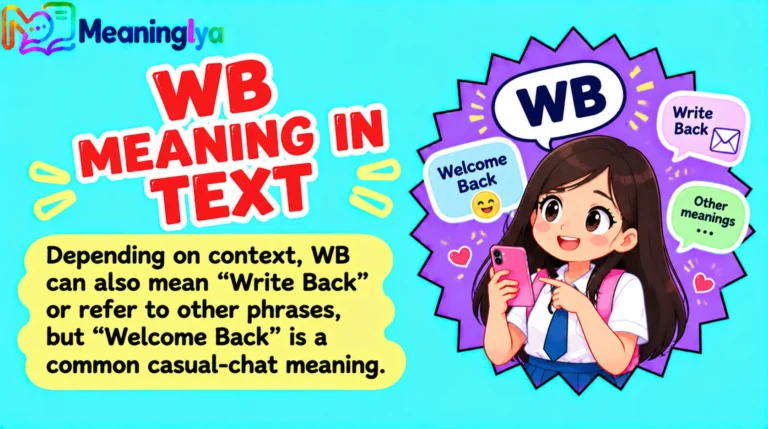
In texting, WB most commonly means “Welcome Back.” People use it when someone returns to a chat, comes online again, or joins a conversation after being away. Depending on context, WB can also mean “Write Back” or refer to other phrases, but “Welcome Back” is a common casual-chat meaning.
The Most Common Meanings of “WB”
The abbreviation WB can have different meanings depending on the conversation. The most useful way to understand it is to look at what happened before the message.
1. WB Means Welcome Back
The most common meaning of WB in casual texting is “Welcome Back.”
People send it when someone returns after leaving a chat, coming home, reconnecting to a game, or becoming active online again. It is usually friendly and shows that the person noticed your return.
Example:
- Person A: “Sorry, I had to leave for a while.”
- Person B: “WB!”
- Meaning: “Welcome back!”
Another example:
- Friend: “I’m back from lunch.”
- You: “WB, how was your food?”
Here, WB is a short, friendly greeting. It does not need a long explanation.
2. WB Means Write Back
In some messages, WB can mean “Write Back.” This meaning is less common in everyday casual chats, but it can appear when someone asks you to reply.
The sender may use it when they want an answer to a message, especially in a short note or informal conversation.
Example:
- “Let me know what you think. WB.”
- Meaning: “Write back.”
However, you should not automatically assume that WB means “Write Back.” Look at the sentence and the conversation. If someone has just returned to a chat, “Welcome Back” is more likely.
3. WB as a Name, Brand, or Other Abbreviation
WB can also refer to something unrelated to texting slang. For example, it may be used as an abbreviation for a company, a name, or a topic in a specific community.
In a conversation about entertainment, business, or a particular group, WB might have a special meaning known to the people involved.
Example:
- “I watched a new WB movie.”
- Meaning: The abbreviation may refer to a company or brand, depending on the discussion.
The key point is that not every use of WB is internet slang. Context helps you identify the intended meaning.
4. WB in Gaming and Online Communities
In gaming chats, WB often means “Welcome Back” when a player returns to a lobby, server, or group.
It can also be used in online communities when a member reconnects after being inactive. The message is usually quick and friendly.
Example:
- Player A: “My internet is working again.”
- Player B: “WB!”
- Meaning: “Welcome back!”
In some gaming groups, members may also use other abbreviations with special meanings. If WB does not fit the conversation, check the surrounding messages before replying.
How “WB Meaning in Text” Is Used in Real Conversations
WB is a short expression that fits many casual online situations. Its meaning stays similar, but the tone can change slightly depending on the platform and the relationship between the people chatting.
Friends & Casual Texting
Among friends, WB is often a quick way to greet someone who has returned.
You might use it when a friend comes back after dinner, finishes a shower, returns from school, or opens a chat again. It saves time and sounds relaxed.
Examples:
- “Back now.” — “WB!”
- “I was busy for an hour.” — “WB, what happened?”
- “Just got home.” — “WB!”
Friends may also add extra words to make the greeting warmer:
- “Welcome back!”
- “WB bro!”
- “WB, missed you!”
The choice depends on how close you are. A simple “WB” is enough for a casual conversation.
Instagram & Snapchat
On Instagram and Snapchat, people often use short messages because chats move quickly. WB may appear when someone returns to a DM, replies after being inactive, or starts talking again.
Example:
- Friend: “Sorry, I disappeared. Had homework.”
- You: “WB, all good.”
On Snapchat, someone might return to a conversation after viewing a story or being away from the app. In that case, WB can be a casual welcome.
However, there is no universal rule that WB always means “Welcome Back” on every social media platform. If the message seems unclear, look at the preceding conversation.
Dating Apps
On dating apps, WB can be used when someone returns to a conversation after a break. It is generally a friendly and casual expression, not automatically a romantic one.
Example:
- Person A: “Hey, sorry for the late reply.”
- Person B: “WB, how’s your day going?”
The message may show that the sender is open to continuing the conversation. But it does not prove that they are flirting or interested romantically.
Tone depends on the rest of the chat. A warm follow-up question may feel more welcoming than a one-word response.
Gaming & Online Communities
Gaming communities use short abbreviations to keep conversations fast. WB is useful when a player reconnects after a break or returns to a team chat.
Examples:
- “My PC restarted.” — “WB!”
- “Back in the lobby.” — “WB, ready?”
- “I’m online again.” — “WB!”
In a group chat, several people may respond with WB at once. It is usually a friendly sign that the person is noticed and accepted back into the conversation.
Work or Professional Chat
WB is less suitable for formal workplace messages. Some teams use casual abbreviations, especially in internal chats, but not every coworker will understand them.
Casual internal example:
- “Back from lunch.” — “WB!”
More professional example:
- “Welcome back. Let me know when you are available to continue.”
If you are unsure about the workplace tone, write the full phrase instead. Clear communication is more important than saving a few characters.
Is “WB” Rude, Flirty, or Offensive?
WB is usually friendly and harmless when it means “Welcome Back.” It is not normally rude, flirty, or offensive by itself.
Still, the tone depends on the context, the sender, and the way the message is written.
When WB Feels Positive
WB can feel warm when someone uses it to greet you after a break. It may show that they noticed you were gone and are happy to continue chatting.
Example:
- “WB! How was your trip?”
The exclamation mark and follow-up question make the message feel welcoming.
When WB Feels Neutral
A plain “WB” may sound neutral, especially in a busy group chat or gaming lobby. The sender may simply be acknowledging your return.
Example:
- “I’m back.”
- “WB.”
There is no strong emotional meaning here. It is just a short greeting.
When WB Might Feel Cold
If someone replies with only “WB” after you share something important, the message may feel too brief. But this does not automatically mean they are annoyed.
They may be busy, distracted, or unsure what else to say. One short abbreviation is not enough to judge someone’s feelings.
Is WB Flirty?
WB is not normally a flirty abbreviation. It can appear in a romantic conversation, but the letters themselves do not show romantic interest.
For example:
- “WB, how was your day?”
This could be friendly or romantic depending on the relationship. Look at the broader conversation instead of reading too much into one short message.
Is WB Offensive?
WB is generally not offensive when used to mean “Welcome Back.” It does not contain an insult or an inherently harmful expression.
However, any abbreviation can be misunderstood if the conversation is tense or the sender uses it sarcastically. When in doubt, consider the tone of the entire message.
How to Respond When Someone Says “WB”
The best reply depends on what the sender means and how casual the conversation is. If WB means “Welcome Back,” you can respond with a greeting, a joke, or a simple acknowledgment.
Casual Replies
These replies work well with friends and familiar people:
- “Thanks!”
- “Thank you, I’m back.”
- “Hey, what’s up?”
- “Good to be back.”
- “Thanks, how are you?”
Example:
- Friend: “WB!”
- You: “Thanks! What did I miss?”
This keeps the conversation moving naturally.
Funny Replies
If you and your friends enjoy jokes, you can use a playful answer.
- “The legend has returned.”
- “Thanks, I survived.”
- “Back from the dead.”
- “Did you miss me?”
- “I have returned!”
These replies are best for people who understand your humor. Avoid jokes that could sound rude in a serious conversation.
Neutral Replies
A neutral response is useful when you are unsure about the tone.
- “Thanks.”
- “Hey.”
- “I’m back.”
- “Appreciate it.”
- “What’s going on?”
A simple “Thanks” is usually enough if someone says WB as a greeting.
Professional Replies
In a work chat, choose a clear and polite response.
- “Thank you. Good to be back.”
- “Thanks. I’m available now.”
- “Thank you. I’ll review the updates.”
- “Thanks, let’s continue.”
These responses are more suitable when talking to a manager, client, or colleague in a formal setting.
What If WB Means Write Back?
If the context suggests “Write Back,” respond to the request rather than treating it as a greeting.
Example:
- Person: “Please check the details and WB.”
- You: “Sure, I’ll review them and reply soon.”
If you are not sure what the sender means, you can ask:
“Do you mean welcome back or write back?”
That is a clear way to avoid confusion.
Common Misunderstandings About “WB”
Short abbreviations can be easy to misread. Here are some common mistakes people make when they see WB.
1. Assuming It Always Means Welcome Back
Although “Welcome Back” is a common meaning, WB is not limited to it. The sentence and conversation may point to another meaning.
Example:
- “Please WB when you can.”
Here, “Write Back” may be intended.
2. Thinking WB Is Always Flirty
Some people assume that a short message from someone they like must have a hidden romantic meaning. WB alone does not prove that.
A person may simply be welcoming you back to the chat.
3. Treating a Short Reply as Rude
A one-word message can look cold, but it may be normal in a fast-moving conversation. The sender may be busy or using a simple texting style.
Look at their usual communication style before deciding that they are being rude.
4. Confusing WB With Other Abbreviations
WB can look similar to other short terms, especially when you read quickly. For example, “WBU” means “What About You?” and “BRB” means “Be Right Back.” These have different meanings.
Learning the difference helps you understand messages more accurately.
5. Assuming Everyone Knows the Same Slang
Not everyone uses the same abbreviations. A friend may know WB immediately, while a parent, teacher, or coworker may not.
Using full words is often better when speaking with someone who may not understand texting slang.
Similar Slang Terms You Should Know
Here are 10 related texting abbreviations that can help you understand online conversations.
- BRB — Be Right Back; used when someone is leaving briefly.
- BBS — Be Back Soon; tells someone you will return shortly.
- TTYL — Talk To You Later; used when ending a conversation temporarily.
- WBU — What About You?; asks the other person the same question.
- HBU — How About You?; another way to ask about the other person.
- GTG — Got To Go; means the sender needs to leave.
- AFK — Away From Keyboard; common in gaming and online chats.
- OMG — Oh My God; expresses surprise or excitement.
- IDK — I Don’t Know; used when someone is unsure.
- LOL — Laughing Out Loud; often shows amusement or a light tone.
Knowing these abbreviations makes it easier to understand short messages without stopping the conversation.
When You Should Avoid Using “WB”
WB is useful in casual chats, but there are times when writing the full phrase is a better choice.
Professional Settings
In formal emails, business messages, and client communication, “Welcome back” is clearer than WB.
For example:
- Less formal: “WB!”
- Professional: “Welcome back. I hope you had a good break.”
A professional message should be easy for every reader to understand.
Cross-Cultural Chats
People from different countries may use different texting abbreviations. Someone who is learning English may not know what WB means.
If you are chatting with an international friend or a new contact, using the full phrase can prevent confusion.
Sensitive Situations
When someone returns after a difficult event, a serious absence, or a personal problem, a short abbreviation may not express enough care.
Instead of simply writing “WB,” you could say:
- “Welcome back. How are you feeling?”
- “It’s good to hear from you.”
- “I hope things are getting better.”
These messages show more thought and support.
When the Meaning Is Unclear
If WB could mean “Welcome Back” or “Write Back,” avoid guessing in an important conversation. Write the complete phrase or ask the sender to clarify.
Clear wording is always better than a misunderstanding.
FAQs
1. What does WB mean in text messages?
WB most commonly means “Welcome Back.” It is used when someone returns to a chat, game, or online conversation.
2. Does WB mean Welcome Back on Snapchat?
Yes, WB can mean “Welcome Back” on Snapchat when someone returns to a conversation. The exact meaning depends on the context.
3. Can WB mean Write Back?
Yes. In some messages, WB means “Write Back,” especially when someone asks you to reply. Check the sentence to understand which meaning fits.
4. Is WB a rude word?
No. WB is usually a friendly abbreviation for “Welcome Back.” It may sound brief, but it is not normally rude.
5. Is WB a flirty abbreviation?
Not by itself. WB is generally a casual greeting. Its tone may feel romantic only because of the wider conversation or relationship.
6. How do you reply to WB in texting?
You can say “Thanks,” “Hey, good to be back,” or “What did I miss?” A simple “Thanks!” is a natural reply.
7. Should I use WB in professional messages?
It is better to use “Welcome back” in formal or professional communication. The full phrase is clearer and more polite for all readers.
CONCLUSION
WB most commonly means “Welcome Back” in text messages. It is a short, friendly way to greet someone who has returned to a conversation, social media chat, or gaming group.
In some contexts, WB may mean “Write Back,” so always consider the words around it before deciding what the sender means.
The abbreviation is usually harmless and casual, but it may not be suitable for formal messages or sensitive situations.
Understanding texting slang helps you communicate with confidence. When the meaning is clear, WB is a quick and useful greeting.
When it is not clear, asking for clarification or writing the full phrase is the smarter choice.

Graham Prescott is a language enthusiast who enjoys exploring English words, meanings, and modern expressions. He writes clear, easy-to-understand content to help readers improve their vocabulary and everyday English.