
What Does “idek meaning in text” Mean?
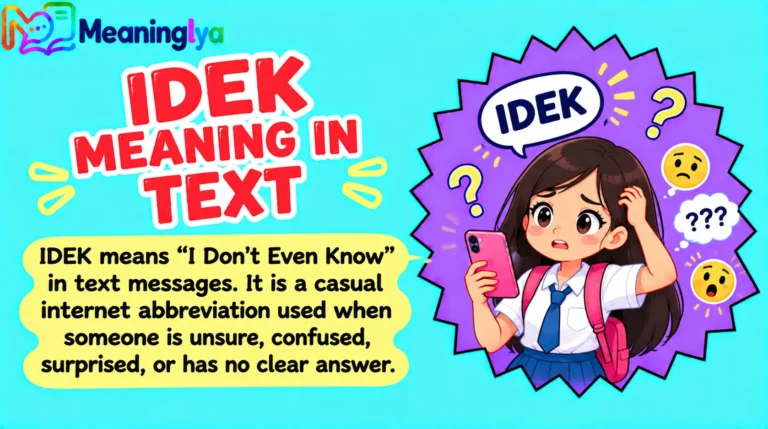
IDEK means “I Don’t Even Know” in text messages. It is a casual internet abbreviation used when someone is unsure, confused, surprised, or has no clear answer.
It can also show frustration, humor, or disbelief, depending on the conversation. You may see IDEK in texts, Instagram DMs, Snapchat, TikTok comments, and online chats.
Imagine your friend sends you a message saying, “idek what happened today.” You understand the words, but the short form may leave you wondering what they really mean. Are they confused? Upset? Or simply joking?
This is why many people search for the idek meaning in text. Internet slang changes quickly, and short abbreviations are now a normal part of everyday communication.
IDEK is one of the most common ways people express uncertainty or a lack of knowledge without typing a full sentence.
Understanding this term can help you follow conversations on social media, messaging apps, and gaming platforms.
It can also help you choose the right response when someone uses it with you.
In this guide, you will learn what IDEK stands for, how people use it in real conversations, whether it sounds rude or friendly, and how to respond naturally.
By the end, you will know exactly what IDEK means and when to use it.
The Most Common Meanings of “idek meaning in text”
IDEK has one main meaning, but people use it in several ways. The exact feeling depends on the words around it, the situation, and the relationship between the people chatting.
1. I Don’t Even Know
This is the standard meaning of IDEK. Someone uses it when they do not know an answer or cannot explain something.
Example:
Friend: Why did Ali leave the group?
You: IDEK. He just left.
Here, IDEK simply means “I don’t even know.” The speaker does not have the information.
2. Confusion or Uncertainty
IDEK can show that someone feels confused about a situation. They may not understand what happened or what they should do next.
Example:
“IDEK what I’m supposed to do now.”
The person is unsure about their next step. The abbreviation makes the message sound natural and informal.
3. Surprise or Disbelief
Sometimes IDEK expresses surprise. A person may use it when something seems strange, unexpected, or difficult to believe.
Example:
“IDEK how she finished that project in one day.”
The speaker may be impressed or shocked by how quickly the project was completed.
4. Frustration or Emotional Overload
IDEK can also suggest that someone feels tired, stressed, or unable to make sense of a problem.
Example:
“IDEK anymore. Everything is getting too much.”
In this case, the phrase carries more emotion than a simple lack of knowledge. The speaker may need support rather than a factual answer.
5. A Playful or Funny Reaction
Friends often use IDEK for humor. The speaker may know part of the answer but use the abbreviation to sound dramatic or playful.
Example:
“IDEK why I bought another pair of shoes.”
The person may understand their reason but is joking about their shopping habit.
How “idek meaning in text” Is Used in Real Conversations
IDEK appears in many digital spaces. Its meaning usually stays the same, but its tone can change based on where it is used.
Friends & Casual Texting
Among friends, IDEK is often a quick way to say “I don’t know.” It saves time and fits the relaxed style of texting.
People may use it to answer questions, share confusion, or react to unexpected news. It can appear at the start, middle, or end of a sentence.
Example 1:
Friend: What time are we meeting?
You: IDEK, maybe around 7?
The speaker is unsure about the meeting time.
Example 2:
Friend: Why is everyone acting weird?
You: IDEK lol.
This reply suggests the speaker does not understand the situation. The casual wording keeps the conversation light.
Example 3:
Friend: Did you finish your homework?
You: IDEK, I haven’t checked.
Here, IDEK is used as an informal response to a simple question.
In friendly conversations, IDEK rarely needs a formal explanation. Most people who use texting slang understand it immediately.
Instagram & Snapchat
On Instagram and Snapchat, IDEK is common in direct messages, story replies, captions, and comments.
Social media conversations often move quickly. People use short terms like IDEK to react to posts, explain their thoughts, or answer questions without writing long messages.
Example 1: Instagram DM
Friend: Did you see that new trend?
You: IDEK what that is, tbh.
The person has not understood the trend and is being honest about it.
Example 2: Snapchat chat
Friend: Why did you send me that picture?
You: IDEK, I was bored.
The reply may sound playful or casual, depending on the conversation.
Example 3: Story reply
“IDEK how this view is real.”
Here, IDEK shows amazement or disbelief. The person is impressed by the view.
On social media, capitalization does not usually change the meaning. “idek,” “IDEK,” and “Idek” generally mean the same thing. Lowercase is especially common in casual Gen Z-style texting.
Dating Apps
People also use IDEK on dating apps when talking about preferences, plans, or feelings. The meaning remains “I don’t even know,” but the tone can be more personal.
Example 1:
Match: What are you looking for here?
You: IDEK yet, just seeing how things go.
The person is uncertain about what kind of relationship they want.
Example 2:
Match: Want to meet this weekend?
You: IDEK, my schedule is crazy.
This means the person is unsure about their availability. It is not automatically a rejection.
Example 3:
Match: How are you still single?
You: IDEK haha.
This can be a lighthearted answer. The person may be joking or avoiding a serious explanation.
However, tone matters in dating conversations. If someone repeatedly says IDEK when you ask clear questions about their intentions, they may be uncertain or avoiding a direct answer. Look at their full messages and actions before deciding what they mean.
Gaming & Online Communities
In gaming chats, Discord servers, and online communities, IDEK is often used during matches, team discussions, or reactions to unexpected events.
Example 1:
Player 1: Why did the boss suddenly disappear?
Player 2: IDEK, maybe a bug.
The player does not know the cause and suggests a possible reason.
Example 2:
“IDEK how we won that round.”
This expresses surprise after an unexpected victory.
Example 3:
Teammate: Who changed the settings?
Player: IDEK.
The person is saying they do not know who made the change.
In online communities, IDEK may appear alongside other gaming slang. The surrounding words usually make the meaning easy to understand.
Work or Professional Chat
IDEK is less suitable for formal work communication. It is an informal abbreviation, so it may sound too casual in emails, reports, or messages to clients.
Casual team chat:
Coworker: Do you know when the update is coming?
You: IDEK, I’ll check.
This may be acceptable in a relaxed workplace where informal chat is normal.
Professional alternative:
“I’m not sure yet. I’ll confirm and let you know.”
This version is clearer and more appropriate for clients, managers, and formal communication.
The key difference is the audience. IDEK is not inherently wrong, but a complete phrase often communicates better in professional settings.
Is “idek meaning in text” Rude, Flirty, or Offensive?
IDEK is generally not rude, flirty, or offensive by itself. It is a neutral, casual abbreviation. Its tone depends on the context and how the speaker uses it.
When IDEK Sounds Friendly
A friend may say:
“IDEK haha, that’s so random.”
This sounds relaxed and playful. The speaker is not trying to offend anyone.
When IDEK Sounds Frustrated
Consider:
“IDEK anymore. I’m so tired.”
Here, the abbreviation may show emotional stress or confusion. A caring response could be more helpful than a joke.
When IDEK Sounds Dismissive
Sometimes a person may use IDEK to avoid answering a question.
“Who told you that?”
“IDEK.”
If the question is important and the speaker clearly knows the answer, the reply may feel dismissive. Still, you cannot know their intention from the abbreviation alone.
Can IDEK Be Flirty?
IDEK is not a standard flirting term. However, someone may use it in a playful or shy conversation.
Example:
Person A: Why do you keep smiling at me?
Person B: IDEK lol.
The reply could be playful or shy, but it does not prove romantic interest. Look at the overall conversation, not just one abbreviation.
Does Capitalization Change the Tone?
Usually, no. These forms have the same basic meaning:
- idek
- IDEK
- Idek
Lowercase often feels more relaxed. Uppercase can add emphasis, especially when someone is surprised or frustrated.
How to Respond When Someone Says “idek meaning in text”
The best response depends on what the person means. If they are confused, you can help. If they are joking, you can joke back. If they are stressed, you can show support.
Casual Replies
Use these when chatting with friends or someone you know well.
- “Same, honestly.”
- “Yeah, I have no idea either.”
- “Let’s figure it out.”
- “Fair enough.”
- “I get you.”
Example:
Friend: IDEK what to watch tonight.
You: Same. Let’s pick something random.
Funny Replies
A playful answer works when the conversation is light.
- “Welcome to the club.”
- “The mystery continues.”
- “Guess we’ll never know.”
- “Ask the internet.”
- “That’s a question for future us.”
Example:
Friend: IDEK why I did that.
You: Your brain took a day off.
Use humor only when you are sure the person is comfortable with it.
Neutral Replies
These are useful when you want to understand the situation without sounding too casual.
- “What happened?”
- “Are you unsure about it?”
- “Do you want to talk about it?”
- “What part is confusing?”
- “Can I help you figure it out?”
Example:
Friend: IDEK what to do.
You: What happened? Maybe we can work it out.
Professional Replies
In work-related chats, respond clearly and politely.
- “No problem. I’ll check the details.”
- “Let’s confirm that first.”
- “I’m not sure either, but I’ll find out.”
- “Could you clarify which part is unclear?”
- “I’ll look into it and get back to you.”
Example:
Coworker: IDEK when the report is due.
You: I’ll check the schedule and confirm the deadline.
The goal is to keep the conversation useful and avoid confusion.
Common Misunderstandings About “idek meaning in text”
Although IDEK is simple, people sometimes misunderstand its tone or assume it means something else.
1. Thinking IDEK Always Means Anger
IDEK does not automatically show anger. It can express confusion, surprise, humor, or simple uncertainty.
Example:
“IDEK how you did that!”
This may be praise or amazement, not anger.
2. Assuming IDEK Is Always Dismissive
A short answer may feel cold, but the speaker could genuinely lack information. Consider the entire message and their usual communication style.
Compare:
“IDEK, sorry.”
This sounds more apologetic.
“IDEK. Stop asking.”
This sounds more annoyed because of the added words.
3. Confusing IDEK With IDK
IDEK and IDK are closely related, but they are not exactly the same in every sentence.
- IDK: I don’t know.
- IDEK: I don’t even know.
The word “even” can add emphasis. IDEK may sound more expressive or dramatic.
4. Thinking IDEK Is a Secret Code
IDEK is not a hidden code or special phrase. It is a common English texting abbreviation.
5. Believing IDEK Always Requires a Long Answer
Sometimes someone uses IDEK simply because they do not know. You do not need to ask many questions unless the situation calls for more detail.
6. Assuming Lowercase Means a Different Meaning
“idek” and “IDEK” usually mean the same thing. Capitalization is mostly a style choice.
7. Taking Every IDEK Seriously
Friends may use IDEK as a joke or dramatic reaction. The meaning becomes clearer when you consider the topic and the speaker’s usual tone.
Similar Slang Terms You Should Know
If you understand IDEK, learning related abbreviations will make online conversations easier.
- IDK — I Don’t Know. A simple way to show uncertainty.
- IDC — I Don’t Care. Used to show a lack of concern or interest.
- IDRC — I Don’t Really Care. A softer or more casual version of IDC.
- IKR — I Know, Right? Used to agree strongly with someone.
- TBH — To Be Honest. Used before sharing an honest opinion.
- NGL — Not Gonna Lie. Often introduces a truthful or personal statement.
- IMO — In My Opinion. Shows that a statement is a personal view.
- TMI — Too Much Information. Used when someone shares more personal detail than expected.
- FR — For Real. Shows agreement or emphasizes that something is true.
- SMH — Shaking My Head. Expresses disappointment, disbelief, or annoyance.
- WYM — What You Mean? Often used to ask someone to explain.
- IYKYK — If You Know, You Know. Refers to an inside joke or shared experience.
These abbreviations are common in informal digital communication, but their tone can change depending on the conversation.
When You Should Avoid Using “idek meaning in text”
IDEK is useful in casual messaging, but it is not the best choice for every situation.
1. Professional Settings
Avoid IDEK in formal emails, business proposals, official reports, and messages to clients unless the workplace clearly accepts informal slang.
Instead of:
“IDEK when the meeting starts.”
Write:
“I’m not sure when the meeting starts. I’ll confirm the time.”
A complete sentence sounds clearer and more professional.
2. Cross-Cultural Chats
Not everyone understands English texting abbreviations. If you are speaking with someone who is learning English, using IDEK may create confusion.
Instead of assuming they know the abbreviation, write “I don’t know” or explain it once.
3. Sensitive Situations
If someone is upset, worried, or discussing a serious issue, a short IDEK may sound uncaring.
For example, if someone shares a personal problem, replying only “IDEK” may feel dismissive. A more thoughtful response could be:
“I’m sorry you’re dealing with this. I may not know what to say, but I’m here for you.”
4. Important Questions
When someone needs accurate information, do not use IDEK as a replacement for checking facts. If you can find the answer, offer to help.
5. Formal Education
In school assignments, essays, and academic writing, use the full phrase “I don’t know” when appropriate. Texting slang usually does not belong in formal written work.
FAQs
1. What does IDEK mean in text messaging?
IDEK means “I Don’t Even Know.” People use it to express uncertainty, confusion, surprise, or a lack of knowledge.
2. What does IDEK mean on Snapchat?
On Snapchat, IDEK usually means “I Don’t Even Know.” It can be used in chats, story replies, or captions to express confusion or a casual reaction.
3. Is IDEK the same as IDK?
They are similar. IDK means “I Don’t Know,” while IDEK means “I Don’t Even Know.” IDEK often adds extra emphasis or emotion.
4. Is IDEK rude?
No, IDEK is not normally rude. However, it may sound dismissive if someone uses it to avoid an important question or responds in a cold way.
5. Can IDEK be used in a professional email?
It is best to avoid IDEK in formal emails. Use “I’m not sure” or “I don’t know” for clearer and more professional communication.
6. What should I reply when someone texts IDEK?
You can say “Same,” “What happened?” or “Let’s figure it out,” depending on the situation. If the person seems upset, offer support.
7. Does IDEK mean someone is confused?
It can. IDEK often shows confusion, but it may also mean the person simply does not know something or is joking.
CONCLUSION
The idek meaning in text is “I Don’t Even Know.” It is a casual abbreviation used in messages, social media, gaming chats, and everyday online conversations.
People use IDEK to show uncertainty, confusion, surprise, humor, or frustration. The abbreviation is generally neutral, but its tone depends on the words around it and the situation.
Remember that IDEK is not always a sign of anger, disinterest, or flirting. Pay attention to the full message and the relationship between the people chatting.
Use IDEK freely in relaxed conversations with friends, but choose clearer words in professional or sensitive situations.
Understanding slang is not just about knowing what letters stand for. It is also about understanding the feeling behind the message and responding in a way that fits the conversation.

Graham Prescott is a language enthusiast who enjoys exploring English words, meanings, and modern expressions. He writes clear, easy-to-understand content to help readers improve their vocabulary and everyday English.